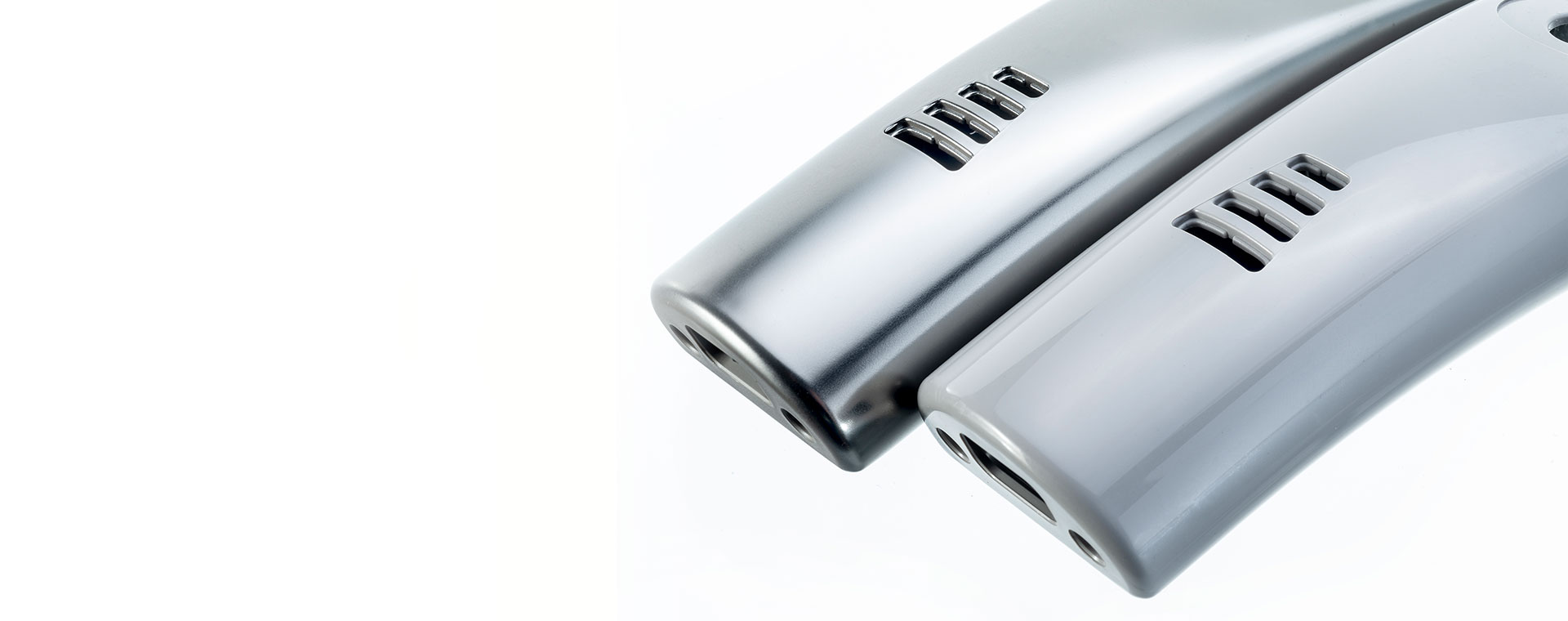
Perfect finishing for plastic parts - Optimum look & haptic.
Prozess

The prerequisites for the optimum appearance of the parts after finishing are laid in our parts production. With the further finishing of plastic parts, we offer you the perfect finish for your components. Depending on the surface required, we do this with our long-standing partners and incorporate their expertise to bring out the best for you: with laser labelling, printing, vapour deposition, painting, chrome plating or hot stamping, we give your parts the finishing touches in terms of look, feel and function.

The finishing of plastic parts often serves several purposes: a more attractive, modern and appealing look can be a reason to finish a component with vapour deposition, printing, hot stamping or painting, for example. However, finishes can also fulfil functions such as enabling the identification or traceability of a part or assembly through labelling. It is also conceivable to increase the resistance of a plastic part by means of a protective coating or to improve its feel.


Fields of application:

  • Consumer products
  • Electronics
  • Electrical engineering
  • Automotive
  • Medical technology
  • Sensors
  • Hydraulics

Our finishing processes for high-quality plastic surfaces

Vapour deposition

The process of vaporising plastics to create a metallic surface can be used for both decorative and technical applications. In addition to increasing the visual appeal of metallised plastic parts, the application of a metal surface can also serve as a shield for electronics.
The PVD vapourisation process takes place in a vacuum and is based on the condensation principle: the material to be coated is heated in a high vacuum to such an extent that it begins to evaporate. The plastic part to be vaporised is located in the vacuum chamber, where it is cooler than the evaporated material and therefore a corresponding layer is deposited on it.

We can print even the finest details on plastics using pad printing. In this printing process, printing ink is first applied to an indentation in the so-called cliché, which corresponds to the desired print motif. An absorbent pad is then pressed onto this ink-filled indentation, which absorbs the ink from the indentation in the desired shape. The pad is then pressed onto the plastic part and transfers the colour to the object in the desired shape. Due to the mouldability of the pad, even curved surfaces of a part can be printed without any problems.

Laser marking, which burns elements such as logos, lettering, but also QR codes or barcodes into the surface of a plastic part to identify a part and its batch, does not require printing ink. This process is often used to apply letters and numbers, but also plays a decisive role in the marking and identification of safety-relevant components. Thanks to the ability to finely guide laser beams, this process makes it possible to fit a lot of information into a very small area.

In hot stamping, prefabricated foils with motifs or metallised surfaces are transferred onto the plastic part. The foil elements are applied with a heated stamp to create a firm bond, which results in the hot-stamped surface elements being slightly raised or recessed on the component.
The advantage of hot stamping is the ability to permanently apply elements to a surface that could not be applied using adhesives or printing.

The painting of plastic parts allows for a vast range of design options, including every conceivable colour and colour combination as well as matt to high-gloss surface finishes. In addition to visual and tactile properties, painting components can also improve their durability: protective coatings help to seal plastics that are otherwise prone to water absorption and counteract sensitivity to chemicals, radiation or gas. For optimum painting results on plastics, in-depth knowledge of the material is required: Adhesion problems during painting can be prevented by special pre-treatment of surfaces. We have mastered the necessary processes such as plasma activation, corona treatment or flame treatment in order to apply a durable high-qualitiy coating to your plastic parts.

The most important advantages of plastic finishing at a glance

  • Visual and haptic upgrading of your product
  • Longer durability
  • Improved resistance to external influences
  • Lightweight alternative to metal parts without visual disadvantages
  • Electrical shielding through metal layer
  • Part labelling for identification and batch traceability

Your direct contact for plastic finishing

Ingo Höfner

Project Management
07721 7509-8521
ingo.hoefner@ke-technik.de