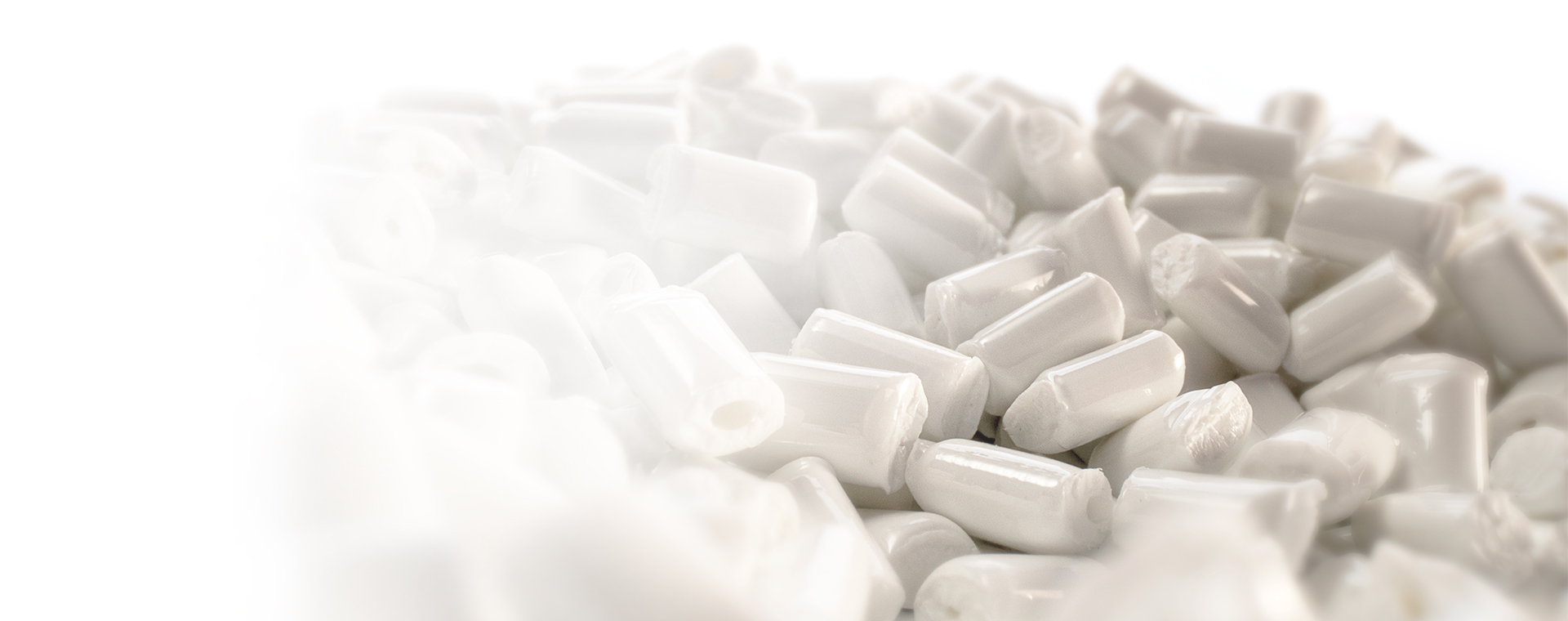
High-quality processing of high-temperature materials.
A plastic that can withstand particularly high temperatures also requires higher mould and processing temperatures for component production. We can optimise the processing of such demanding materials and therefore produce the best parts for you that require the corresponding operating temperatures.
High-temperature plastics in injection moulding: precision for extreme conditions
Common thermoplastics can reach service temperatures of up to 130°C. But plastics can do much more: some materials in the high-temperature plastics class can withstand temperatures of up to 260°C in practice.
This thermal stability makes the injection moulding of these plastics particularly challenging: particularly high plasticising temperatures are required to make these plastics suitable for injection moulding. In addition, the temperature control of the injection mould must also be adapted.
In our thermoplastics production facility, we have the appropriate machines to process these materials such as PPS, PSU or PEEK.
In our thermoset division, we process PF, EP, UP and MF moulding compounds on our eleven injection moulding machines, some of which are fully automated. The employees in this area have many years of experience with the special requirements of the specific material conditions and the process for achieving the required part qualities. Several modern deburring systems are available for the necessary and high-quality deburring of thermoset components, some of which have very high surface requirements.
Fields of application:
- Aerospace
- Food machinery
- Chemical industry
- Parts for car engines, clutches
- Gear wheels
- plain bearings
- Coilformers
- Fittings, valves
High-performance materials at a glance: Properties and advantages
Polyetheretherketone (PEEK)
Polyetherimide (PEI)
Polyethersulfone (PES)
Liquid Cristal Polymer / Liquid Crystal Polymer (LCP)
PEEK is almost as temperature-resistant as Teflon and can withstand continuous loads of up to 250°C. Thanks to its good mechanical properties and high lubricity, it is often used as a technical material for gear wheels or plain bearings in temperature-stressed environments. It has high dimensional stability, good mechanical strength and can be sterilised.
PEI is almost as temperature-resistant as Teflon and can withstand continuous loads of up to 250°C. Thanks to its good mechanical properties and high lubricity, it is often used as a technical material for gear wheels or plain bearings in temperature-stressed environments. It has high dimensional stability, good mechanical strength, is extremely flame-retardant, low-smoke in the event of fire and achieves the highest flame-retardant rating according to all current standards.
PES is an amorphous high-performance plastic with a slightly brownish transparency. Due to its chemical relationship to PSU, PES has similar properties. Like PSU, PES has a significantly higher rigidity and strength compared to other transparent thermoplastics, especially at elevated temperatures. PES has better fire behaviour than the related PSU. The class “flame retardant VO” is already achieved with a lower sample thickness.
LCPs are polymers whose chains form so-called liquid crystalline phases in the melt. In crystals there is generally a fixed order, whereas in liquids/melts the distribution of molecules or atoms is usually largely random. LCPs are resistant to hydrolysis, weak acids and bases, alcohols, aromatics, chlorinated hydrocarbons, esters, ketones and all chemicals that would otherwise cause stress cracking, with the exception of strongly oxidising acids and strong alkalis, over a wide temperature range. The weathering stability and resistance to gamma rays and short waves are good. They are inherently flame-retardant (V0 according to UL 94) and have very good electrical properties – with the exception of low tracking resistance.
The most important advantages of high-temperature plastics at a glance
- high temperature resistance
- usually highly resistant to chemicals
- generally weather proof
- good thermal and electrical insulation
- depending on material type: Non-flammable
- depending on material type: Little or no absorption of moisture
- depending on material type: Very high mechanical strength
Your direct contact for high-performance plastics

Project Management
07721 7509-8521
ingo.hoefner@ke-technik.de