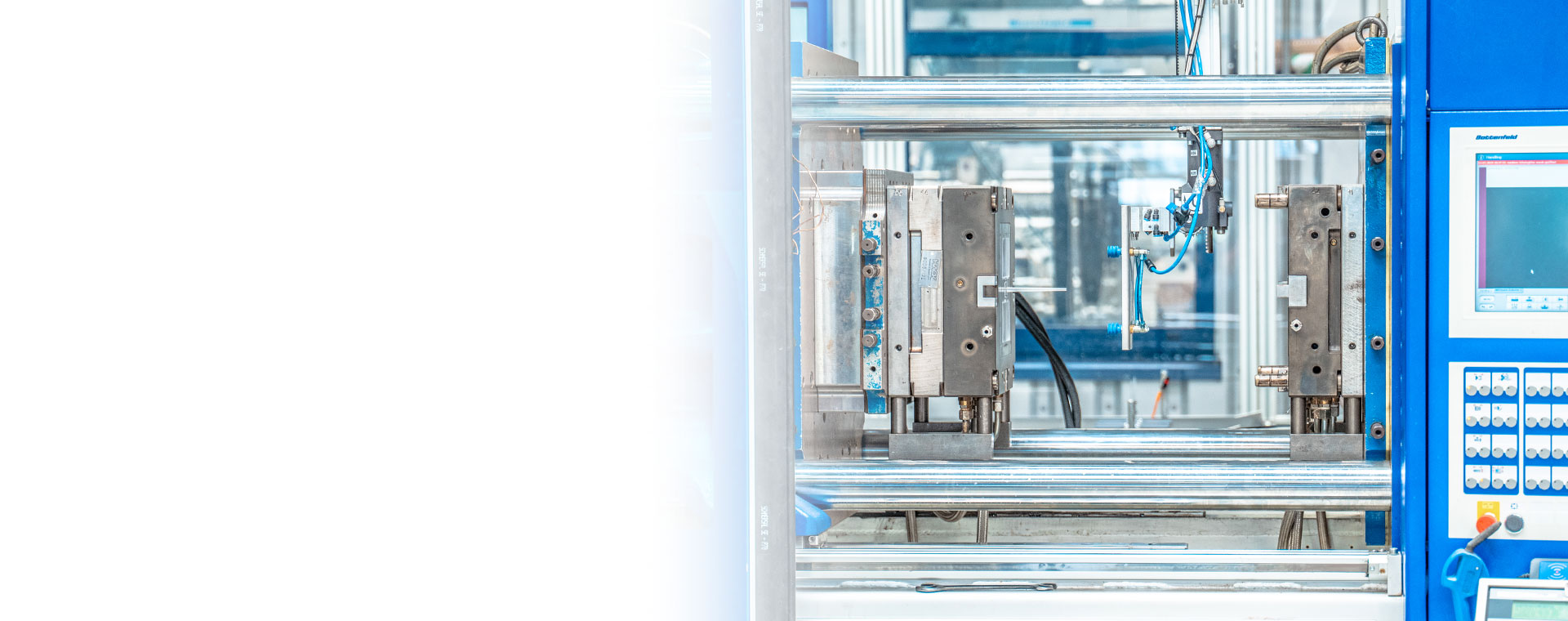
Perfect injection moulding technology - high-quality plastic parts for mechanical engineering.
Manufacturing

If the raw part is not right, even subsequent further processing cannot save the quality. This is why we attach particular importance to optimised plastic injection moulding processes right from the start. The results speak for themselves: we deliver excellent results in the production of thermoset parts, with high-temperature materials, in multi-component injection moulding or with hybrid parts.

The technological basis of production at KE is injection moulding technology for thermoplastics and thermosets. We produce technically sophisticated components in three-shift operation on over 40 machines with clamping forces ranging from 250 KN to 5,000 KN. We process all common engineering thermoplastics, a variety of high-temperature thermoplastics and thermoset materials.

Our parts fulfil the tightest tolerances and extreme requirements for component surfaces, both in the thermoset and thermoplastic areas. Various special processes such as the multi-component process, the use of dynamic temperature control and fully automated processes for the overmoulding and testing of inserts are used to manufacture the components. We also offer finishing processes such as the complete assembly of modules or the refinement of components through printing, coating or painting.

Here we develop our expertise in close collaboration with co-operation partners, always in relation to the wishes and requirements of our customers.

Consistent monitoring of processes and part quality is ensured by our quality management system. The employees responsible for quality ensure the required process and part quality at all times through software-supported systems and the use of state-of-the-art measuring equipment.


Special applications


Injection moulding of high-temperature thermoplastics

High-temperature plastics from the thermoplastics material class are defined by their permanent use at temperatures of more than 150°C. The production of parts from these materials requires special attention to mould temperature control and the machine equipment and peripherals.  (Find out more)


Multi-component injection moulding

The simultaneous injection moulding of different plastics into a single part requires special injection moulding machines as well as special tool technology and experience in order to define the most economical process. We are happy to bring all these points to bear for your product. (Find out more)


Overmoulding of inserts

Whether for protection against mechanical or other stresses, as a decorative addition or as a design element: overmoulding parts with plastics can bring many advantages. We show you how. (Find out more)


Transparent moulded parts

Crystal clear is anything but simple. One of our specialities is the production of parts from transparent plastics – without streaks, without inclusions, without blemishes for optimum quality of your end product. (Find out more)
The plastic injection moulding process – from material preparation to creating the perfect component

Material preparation

Reliable material preparation is an important prerequisite for the production of optimised components. For thermoplastics, the material must be dried before processing. Many thermoplastics are hygroscopic and absorb moisture, which makes processing difficult or impossible. These materials must therefore be pre-dried to a defined and low residual moisture content. KE has one of the latest and most modern systems for material preparation.

For injection moulding, the starting material must first be converted into a liquid form with the correct viscosity. In thermoplastic injection moulding, the granulate or moulding compound is fed into the flights of a rotating screw in the injection unit. The screw moves in a cylinder that is preheated and carries the injection nozzle at its end. Together with the frictional heat generated by the rotation of the screw conveyor, the material is heated to the point where it is liquid enough for injection moulding, i.e. plasticised. At the same time, back pressure is built up in the barrel, which compacts and homogenises the material. When there is enough material, the screw is switched off.

The injection unit, which contains the barrel and the screw with the plasticised material, is pressed against the injection mould with its nozzle on the barrel and the screw is pressurised from behind. As a result, the melt is injected into the injection mould under high pressure (usually between 500 and 2000 bar). The mould contains the shaping cavity, the so-called cavity or mould cavity. Where the melt meets the cooler wall of the mould, it solidifies. The combination of flow speed, temperature and pressure of the molten metal plays a key role in determining the quality of the resulting part.

The molten plastic cools in the mould – but this also leads to a reduction in volume, which has a negative impact on the dimensional accuracy and surface quality of a part. For this reason, pressure is maintained even after the injection mould has been filled so that material can flow in to compensate for the volume shrinkage. After the sprue point – the point in the mould on the mould wall – has also solidified, the injection pressure is stopped and the plastic solidifies in the mould cavity within the set cooling time. A new plasticising cycle can now begin in the cylinder in the injection unit.

In order to be able to remove the finished moulded part from the injection mould, it must first be ensured that it has cooled down sufficiently to retain its shape before the part is pushed out of the mould. The mould can only be opened once the so-called core of the part has become sufficiently rigid. Depending on the sensitivity of the plastic part produced, it is then ejected using ejector pins. Sensitive parts or parts that are produced in large quantities are automatically removed and stored in an organised manner.

The most important advantages of plastic injection moulding at a glance

  • high economic efficiency for large quantities
  • fast cycle times even with high complexity
  • almost freely selectable surface quality
  • large variety of usable materials
  • good repeatability in the run-in process

Your direct contact for plastic injection moulding projects

Lars Moosmann
Lars Moosmann

Project Management
07721 7509-8573
lars.moosmann@ke-technik.de